
Wondering whether your toddler needs speech therapy?
“Are they just a late talker?” or “Should we wait a little longer?” These are questions we hear from parents all the time when it comes to their toddler’s speech and language development.
It’s natural to wonder whether your child will catch up on their own. And while children do develop at different rates, it can be hard to know when to wait and when to ask for guidance.
If you have concerns about your child’s communication, you don’t have to wait until you’re certain there is a problem to ask questions. A speech and language evaluation can help you better understand your child’s current skills, identify areas where they may benefit from a little extra support, and give you a clearer idea of what to do next.
Speech and language: What's the difference?
You might hear the terms speech and language used together, but they actually mean two
different things.
Speech is how your child says words and produces sounds. It includes how clearly they pronounce the individual sounds that make up a word and how they use their mouth, lips, and tongue to make sounds.
Language is how your child understands and communicates ideas. This includes understanding what others say, using words or gestures to express wants and needs, putting words together, and interacting with others through communication.
In simple terms, speech is about how your child says words, while language is about what your child understands and communicates.
A child can have difficulty with speech, language, or both. That’s why it’s important to look at the whole picture when considering your child’s communication development.
When should parents ask for an evaluation?
One of the biggest questions parents have is, “How do I know if my child is actually behind, or just developing at their own pace?”
The truth is that every child develops a little differently, even children growing up in the same family. The American Speech Language Hearing Association (ASHA) provides communication milestones in age ranges to help parents understand what skills children are typically
developing as they grow. ASHA’s communication milestones reflect skills that at least 75% of children who speak English have developed by the end of the listed age range. These milestones are helpful guidelines, but are not intended to diagnose a speech or language delay.
What should you be looking for?
Here are some communication milestones to keep in mind as your child grows. Remember, these are general guides and not a checklist. Missing one skill does not automatically mean your child has a delay.
10 to 12 months
Points, waves, and shows or gives you objects.
Attempts to imitate sounds you make.
Responds to simple phrases like “come here” or “time to go.”
May begin saying one or two words, such as mama, dada, hi, or bye.
13 to 18 months
Follows familiar 1-step directions, such as “Give me the ball.”
Points to request, share joint interest, or get your attention.
Understands and uses words for familiar objects, actions, and people.
Identifies one or more body parts.
19 to 24 months
Understands and uses at least 50 different words.
Starts putting two or more words together, like “more water” or “go outside.”
Follows two-step directions, such as “Get the cup and put it on the table.”
Uses words to ask for help.
2 to 3 years
Uses combinations of words regularly, such as noun+verb; noun+verb+object.
Says their name when asked.
Begins asking questions like “why” and “how.”
Gives simple reasons for own actions and events.
Speech is becoming clearer and more intelligible, although unfamiliar people may not understand everything your child says.
When should you seek an evaluation?
ASHA encourages parents to seek guidance from a speech-language pathologist (SLP) if their child is not meeting many of the milestones in their age range. Furthermore, if you feel your child is making limited progress, is losing skills once previously demonstrated, or if something about your child's communication just doesn't seem right, reach out to a speech-language pathologist. You know your child better than anyone.
Why is early intervention important?
The earlier you understand your child's communication needs, the sooner you can make informed decisions about support. Early childhood is an important time for communication development, and speech therapy can help children build skills for expressing themselves, understanding others, learning, and interacting with the people around them.
It's also important to remember that getting an evaluation doesn't automatically mean your child will need speech therapy. Sometimes, it simply provides reassurance that everything is developing as expected. If additional support is recommended, you'll have a better understanding of your options and what to do next.
What happens during a toddler speech evaluation?
We know that a speech and language evaluation can feel a little overwhelming, especially if you aren't sure what to expect. Our goal is to make the experience as comfortable and stress-free as possible for both you and your child.
An evaluation is not a test your child can pass or fail. It's an opportunity for us to get to know your little one, learn about their communication skills, and hear what's on your mind as a parent.
Here's a little look at what the evaluation process may include!
1. Getting comfortable and building rapport
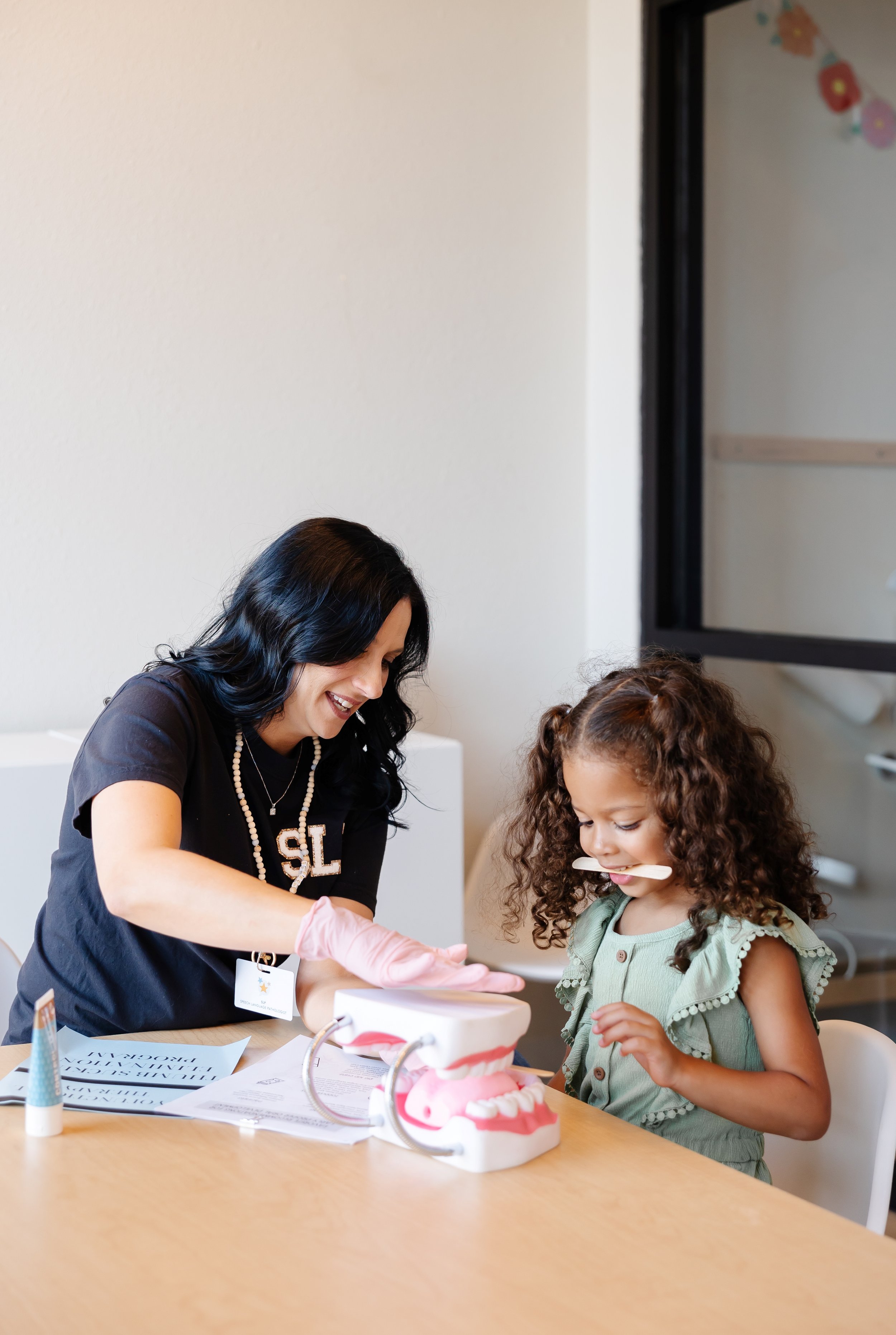
First things first, we want your child to feel comfortable! Your therapist will spend some time getting to know your little one through play, conversation, and observation.
We'll also talk with you about your concerns, your child's developmental history, and the communication skills you've noticed at home. You're the expert on your child, and the things you share help us understand the bigger picture.
2. Play-based assessment
Depending on your child's age and the concerns you have, your therapist may use a formal assessment, informal play-based activities, or parent questionnaires to learn more about your child's communication skills.
We want to see how your child communicates in a natural setting, so toys, books, and play are often a big part of the process!
3. Looking at speech and language skills
Depending on your child's age and overall needs, we may look at several areas of communication, including:
Understanding language: How well your child understands words, questions, and directions.
Using language: How your child communicates wants and needs, uses words, puts words together, and interacts with others.
Speech sounds: Which sounds your child can produce and how clearly they say words.
Fluency and voice: We'll listen to the flow and rhythm of your child's speech and their overall vocal quality.
Oral structures and movement: When appropriate, we'll look at the structures in and around your child's mouth and how they move for speech.
4. Discussing the results and next steps
Once the evaluation is complete, your therapist will go over the findings with you, explain your child's strengths and areas that may need additional support, and answer your questions. At Pediatric Speech Stars, you’ll receive a written comprehensive evaluation report within 7 days unless otherwise specified by your evaluating therapist.
Depending on the results, recommendations may include:
Your child is on track with speech and language development, and no additional support is needed right now.
Speech therapy is recommended to help support specific communication skills.
Another evaluation or referral may be helpful.
If speech therapy is recommended, we'll discuss goals and develop a plan that fits your child's needs. We'll also share ideas you can use at home to encourage communication during everyday activities.
How can you prepare for the evaluation?
You don't need to do anything special to prepare your toddler, but a few things can help us get a better understanding of their communication:
Complete the Child Intake form sent to your email.
Jot down some of the words, sounds, and gestures you hear your child use.
Take short videos of your child communicating or playing, as they are sometimes reserved/shy when an unfamiliar adult is in their environment.
Make note of any communication concerns, frequent ear infections, or relevant developmental history.
Tell us about all the languages your child hears and uses at home.
Bring any questions or concerns you'd like to discuss.
Our goal is to make sure you have answers by the end of the evaluation! Whether your child needs additional support or simply a little reassurance, we want you to feel informed and confident about the next steps. Most importantly, we want you to know that you're not navigating your child's communication journey alone.
What does in-home speech therapy look like?
For toddlers, speech therapy often looks a lot like playtime! Sessions are designed around your child's interests and use fun, meaningful activities to encourage communication and language development. Toys, books, songs, snacks, and everyday routines all create opportunities for learning.
We also believe that caregivers are an important part of the process. During sessions, your therapist will show you simple strategies you can use to encourage communication, then coach you as you practice them with your child. This gives you a chance to see what works and feel confident supporting your child’s communication development between visits.
We often organize activities around a theme to make learning engaging and help children connect new words with familiar experiences. For example, during a farm theme, your therapist might bring a toy farm set with animals, read a farm-themed book, sing animal songs, or create a simple farm craft. Each activity provides natural opportunities to practice new skills.
While playing with the farm animals, your child might practice:
Learning and using new words, such as cow, horse, barn, and tractor.
Making animal and environmental sounds, like moo, neigh, and vroom.
Following one- and two-step directions, such as “Find the cow” or “Pick up the pig and put it in the barn.”
Combining words and building longer phrases and sentences.
Taking turns, sharing, and developing play skills.
We also look for ways to carry these skills into everyday routines. During snack time, for example, you can encourage your child to request “more crackers,” choose between two foods, or follow directions like “Put the cup on the table.”
Looking at books together is another opportunity to name pictures, describe what is happening, and talk about familiar objects. Even bedtime and getting dressed can become chances for you and your child to practice words, follow simple directions, and engage in simple conversations
between visits.
Our goal is to help your child build communication skills through enjoyable activities and help you feel confident using those same strategies throughout the day. The more opportunities your child has to practice during everyday moments, the more naturally those skills can become part of their daily life.
Getting started with Pediatric Speech Stars
You don't have to figure it out on your own. If you have questions or concerns about your child's communication development, we would love to hear from you!
Once you contact us, we'll connect with you to learn a little more about your child, answer your initial questions, and explain the next steps. We'll also help you understand the evaluation process and connect you with your evaluating therapist. At Pediatric Speech Stars, we serve children in Southlake, Trophy Club, Roanoke, Grapevine, Colleyville, and surrounding areas.
Are you ready to get started? Contact us HERE. We'd be happy to help you take the next step!
Helpful ASHA Resources
For parents who would like to learn more about communication development, these resources from the American Speech Language Hearing Association (ASHA) are a great place to start:
ASHA's communication milestones are intended as general developmental guidance, not as a screening or diagnostic tool. If you have concerns about your child's speech and language skills, speak with a qualified speech-language pathologist.