
School-Based Speech Therapy vs. Private Practice Speech Therapy: What’s the Difference?
If your child is having difficulty with speech, language, or functional communication, you may be wondering whether school-based speech therapy or private practice speech therapy is the right choice. While both provide valuable support from licensed Speech-Language Pathologists, they serve different purposes and have different eligibility requirements and approaches to treatment.
Understanding these differences can help you determine which type of support best meets your child’s needs and whether your child may benefit from receiving both.
What Is School-Based Speech Therapy?
School-based speech therapy is a free educational service provided through the public school district to children who meet special education eligibility requirements. The primary focus is how a child’s communication difficulties affect their ability to access, participate in, and make progress within the educational environment.
For a child to qualify for school-based speech therapy, the Full and Individual Evaluation (FIE) must identify a communication disorder, demonstrate that the disorder adversely affects educational performance, and determine that the child requires specially designed instruction or support from a Speech-Language Pathologist to make progress in the educational setting.
Once a child meets eligibility requirements, the school will outline the specialized support, including speech therapy, in the child’s Individualized Education Program (IEP). Speech therapy services are typically provided during the school day and typically occur in a group, although may occur individually.
What Is Private Practice Speech Therapy?
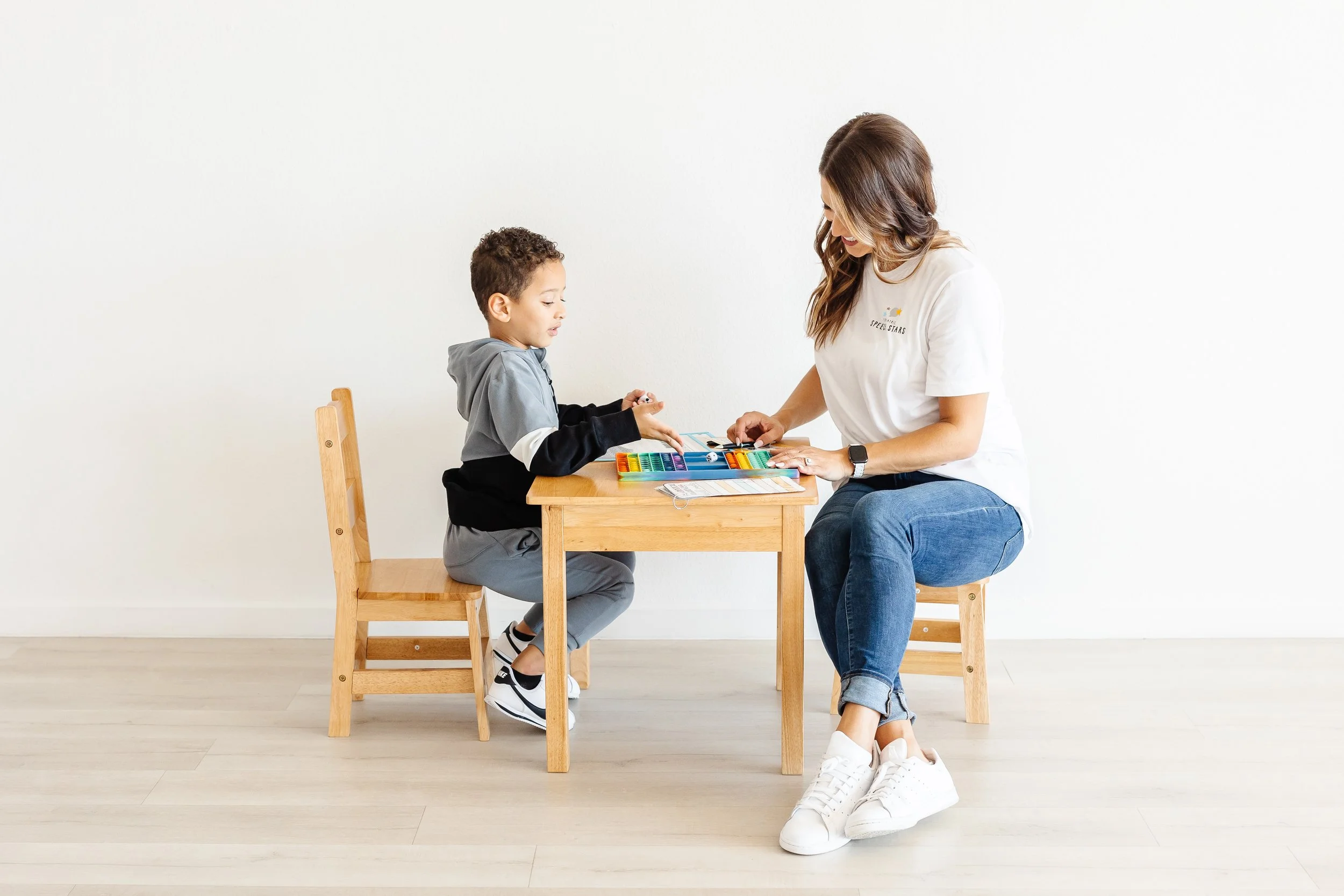
Private practice speech therapy provides individualized clinical care focused on a child’s overall communication and functional needs. Unlike school-based services, private therapy is not limited to educational impact and can address a broader range of communication goals across settings.
Evaluation and treatment plans are tailored to your child’s individual strengths, needs, goals, and family priorities. Private practice speech therapy can be provided in a variety of settings, including the home, preschool/daycare, ABA centers, or virtually, depending on the child’s needs. In-home and community-based therapy can be especially beneficial because it allows children to practice communication skills in familiar, naturalistic environments where those skills are used every day.
Key Differences Between School-Based and Private Practice Speech Therapy
Although both services are provided by licensed Speech-Language Pathologists, their purpose and approach to treatment are different. School-based speech therapy is educationally focused and addresses communication difficulties that affect a child’s ability to participate and make progress at school.
Private practice speech therapy follows a more individualized clinical model and can address broader communication needs. School-based services require a child to meet specific special education eligibility criteria, whereas private speech therapy is based on the child’s clinical needs and treatment goals.
Private speech therapy may also offer greater flexibility in location, scheduling, frequency, and individualized treatment. Parent involvement is another important component, with private practice often incorporating ongoing parent coaching and education to help families use communication strategies throughout daily routines.
Ultimately, school-based and private practice speech therapy are not competing services. Depending on a child’s needs, they may benefit from one or both.
Benefits of Private Practice Speech Therapy
One of the biggest benefits of private practice speech therapy is the individualized approach to care. One on one sessions allow the Speech-Language Pathologist to tailor the evaluation, treatment, therapeutic activities, and goals to the child’s unique strengths and needs.
Private speech therapy can address a broad range of communication skills, including articulation, receptive and expressive language, social communication, play skills, fluency, voice, functional communication, and early language development. Treatment goals can also be adjusted as a child progresses and their needs change, allowing therapy to remain appropriate throughout the course of treatment.
Another benefit of private practice is the family-centered approach. Parent coaching can be incorporated during or immediately after sessions, giving caregivers practical strategies they can use throughout everyday routines. Activities such as play, mealtimes, bedtime, and interactions with siblings provide natural opportunities for families to practice and reinforce communication skills outside of therapy.
Private speech therapy can also be provided in naturalistic environments, such as the home, preschool, daycare, or ABA center. Working in familiar environments allows the Speech-Language Pathologist to observe communication skills in everyday situations and help children practice functional skills where they naturally occur. This can support the carryover and generalization of communication skills across settings.
Can My Child Receive Both?
Yes! In many cases, children can receive both school-based and private speech therapy. The two services can complement one another because they address different aspects of a child’s communication needs.
School-based therapy can support communication within the classroom and educational environment, while private speech therapy can address speech and language needs across the home, school, and community settings. When appropriate, the two providers can also collaborate to promote consistent strategies and support carryover.
Ready to Take the Next Step?
School-based and private speech therapy each serve an important purpose, and the right choice depends on your child’s individual communication needs and where they need support. Some children benefit from school-based services, others from private therapy, and some from both. The goal is to find the support that helps your child make meaningful progress across the environments where they live, learn, and play.
At Pediatric Speech Stars, we provide individualized pediatric speech therapy throughout Northeast Tarrant County, including Southlake, Trophy Club, Westlake, Colleyville, and Grapevine. Therapy may be provided in the home, preschool, private school, daycare, or ABA center, as well as virtually throughout Texas. We also offer continuous speech therapy throughout the year, including school breaks and summer. Contact Pediatric Speech Stars today to discuss your child’s needs and schedule an evaluation.